
Last updated: June 2026 · Reading time: 15 min
Quick answer: Positano is the most photogenic town on the Amalfi Coast — and also the most crowded, the most vertical, and the most expensive. Go in May, September, or early October. Stay at least one night. Arrive by ferry if you can. And pack shoes you can actually walk in, because there are stairs everywhere, and we mean everywhere.
Let’s be straight with you from the start: we’ve been coming to Positano for over 15 years, by motorcycle, by car, by ferry, and once memorably by foot from Praiano. We’ve come as a couple and with two kids. We’ve watched it get progressively more famous, more expensive, and more crowded every single year. And yet we keep coming back.
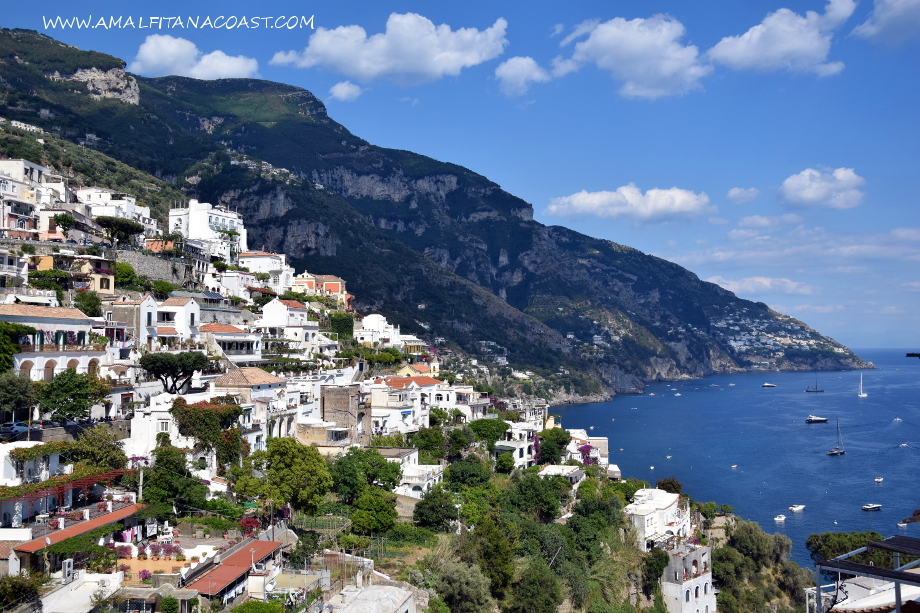
Because Positano is, without much competition, the most visually extraordinary town on the Amalfi Coast. The pastel houses stacked up the cliff in impossible layers, the bougainvillea spilling over every wall, the green dome of Santa Maria Assunta against the blue of the sea — it’s one of those places that looks exactly like its photos and still manages to exceed them in person. That’s rare.
Here’s what we actually know about it.
The one thing nobody tells you about Positano
Positano is a vertical town. Not mildly hilly — genuinely, relentlessly, breathtakingly vertical. The main road (SS163, also called Via G. Marconi) runs along the top. The beach is at the bottom. Between them: hundreds of steps, narrow lanes, and staircases carved into the rock.
This matters for everything — where you book a hotel, how much luggage you bring, how you plan your days, and whether it’s manageable with children or older family members. Our eldest made it fine by age six; a stroller is essentially impossible. When we visit with the kids, we plan the day around going down to the beach in the morning and coming back up only once.
The practical rule: before booking any hotel in Positano, check how many steps it is from the nearest bus stop and from the beach. Google Maps satellite view helps. So does calling ahead and asking. A hotel that looks central on a map can be 200 steps from any road.
What to See in Positano
1. The Church of Santa Maria Assunta — and the legend behind it
The most recognizable image of Positano is the majolica-tiled dome of this church, green and yellow, visible from the sea and from almost everywhere in town. It’s more than a pretty building.
Inside, behind the altar, hangs a Byzantine icon of the Black Madonna — a dark-skinned Madonna with Child, dating to around the 12th century. The legend says a ship carrying the icon was passing the coast when it suddenly stopped, unable to move despite calm seas. The sailors heard a voice saying “posa, posa” (set it down, set it down). They brought the icon ashore, and a church was built on that spot. The town’s name, it’s said, comes from those two words.
Whether you believe the legend or not, the icon is genuinely striking — small, dark, worn with age, surrounded by silver offerings and votive candles. Most visitors photograph the dome from outside and walk straight past the interior. Don’t. It’s free, it’s cool, and it’s the actual soul of the town.
Next to the church entrance, a recently excavated Roman domus — a seaside villa with frescoes similar to Pompeii — is open for guided visits year-round. It’s small but excellent and almost nobody goes.
2. Spiaggia Grande — managed expectations required
The main beach is beautiful in the way that all Amalfi Coast beaches are beautiful: dark pebbles, turquoise water, dramatic backdrop of cliffs and houses. It’s also extremely small relative to the number of people who want to be on it.
In July and August, the free section fills up by 9am. The beach clubs — and there are several — rent sunbeds and umbrellas at prices that range from around €20 to €90+ per person depending on position and season. Yes, €90 per person. Positano doesn’t do budget beach days.
Our honest approach: if you’re visiting in peak season, book a beach club spot in advance or arrive by 8am for a free spot. If you’re visiting in May or September, you can show up whenever and find space. The water in early October is still warm enough to swim and the beach is nearly empty.
3. Fornillo Beach — the better option nobody talks about
A 15-20 minute walk from Spiaggia Grande along the Via Positanesi d’America coastal path (one of the nicest short walks on the coast, with views the whole way) brings you to Fornillo. Smaller, less crowded, cheaper beach clubs, and somehow less famous despite being just as beautiful. We almost always end up here when we visit with the kids — it’s calmer, the path from town is manageable, and there’s a bar.
4. The View from Via Cristoforo Colombo (no. 44)
There’s a specific balcony viewpoint at Via Cristoforo Colombo 44 that produces the most iconic photo of Positano — the one where you see the whole town laid out below you with the sea in the background. Every travel photographer knows it. It’s completely free, takes five minutes, and requires walking uphill from the main road. Worth every step.
Do it in the morning before 9am when the light is right and there’s nobody else there, or in the golden hour before sunset. Midday in summer it has a queue.
5. The Saracen Towers
Positano has three medieval watchtowers — Torre Trasita, Torre di Sponda, and Torre di Fornillo — built to warn the town of pirate raids. They’re not museums, but they’re part of the character of the town and visible from the beach and the sea. Torre Trasita is the most photogenic, now a private villa that occasionally appears in architecture magazines.
6. Walk to Montepertuso and Nocelle
Most visitors never go uphill from the main road. That’s a mistake. The small villages of Montepertuso and Nocelle, perched above Positano, are a completely different world: terraced lemon groves, almost no tourists, old men playing cards in front of the church, views that look down on Positano from above. A local bus connects them to the main road (ask at the SITA bus stop), or you can hike up in about 45 minutes.
Nocelle is also the starting point — or ending point, depending on direction — of the Path of the Gods (Sentiero degli Dei), one of the best hikes on the entire Amalfi Coast.
Tours and Activities From Positano
Boat tours — do this first, everything else second
Seeing Positano from the sea is a different experience from seeing it from land. The cliff face, the sea caves, the hidden beaches only accessible by water, the other towns reflected in the distance — it’s spectacular, and it’s the perspective most visitors never get.
We’ve done both the small group tours (6–8 people, stop for swimming at a sea cave, usually 3-4 hours) and private boat hire. Both are excellent. The small group tours are the better value; private hire is worth it for a special occasion or if you have a larger group.
Book in advance in summer — good spots sell out. The most popular departures leave in the morning for better sea conditions.
👉 Browse and book boat tours from Positano
The Path of the Gods (Sentiero degli Dei)
The most famous hike on the Amalfi Coast runs along the ridgeline above Positano from Bomerano (above Agerola) to Nocelle, with views over the coast for almost the entire 8km. The elevation gain isn’t extreme once you’re on the ridge, but getting up to the starting point takes effort.
It takes around 3.5–4 hours at a comfortable pace. You can hire a guide or do it independently — the path is well-marked. We’ve done both; a guide is worth it for the historical context, not necessary for navigation. Wear proper shoes, bring water, start early to avoid heat.
Practical note: The most common direction is Bomerano → Nocelle (finishing in Positano). This means taking a bus or taxi up to Bomerano, then walking back down to Nocelle and Positano. With the ferry back, it makes a perfect full-day loop.
👉 Book a guided Path of the Gods hike
Day trip to Capri
The ferry from Positano to Capri takes around 40–50 minutes and runs multiple times daily from April through October. A full day on Capri — Blue Grotto in the morning, lunch in Capri town, Anacapri in the afternoon — is one of the best days you can spend from this coast. Buy tickets at the port (or online in peak season).
Cooking classes
The food of the Amalfi Coast — scialatielli pasta, fresh seafood, lemon-based everything — is worth learning to make. Several operators in and around Positano run cooking classes, typically 3–4 hours with lunch or dinner at the end. Consistently one of the highest-rated activities in the area.
👉 Browse cooking classes and experiences near Positano
What to Eat in Positano
Positano is expensive. There’s no getting around it. A plate of pasta at a tourist restaurant on the waterfront can cost €25–35. A beach club lunch can cost €50+ per person. These are real prices that real visitors pay in July and August.
That said, eating well here without going bankrupt is absolutely possible.
What to order:
- Scialatielli ai frutti di mare — the local pasta, thick and handmade, with mixed seafood. This is the dish of the Amalfi Coast. Order it here.
- Totani e patate — squid cooked with potatoes, an old local dish that’s harder to find but excellent when you do.
- Mozzarella in foglie di limone — buffalo mozzarella grilled in lemon leaves, which infuses it with a delicate citrus flavor you won’t find elsewhere.
- Delizia al limone — the lemon cream dessert. From a proper pasticceria, not a tourist shop. The quality difference is enormous.
- Fresh fish, simply cooked — grilled, acqua pazza (poached in water, tomatoes, and herbs), or with a drizzle of local olive oil. The simpler the preparation, the better the fish usually is.
Where to save money:
The bars and simple restaurants on the upper road (Via G. Marconi and Viale Pasitea) are significantly cheaper than anything near the beach or the church. A coffee at the bar (standing up, Italian-style) costs €1.50. The same coffee on a sea-view terrace costs €5–8. Eat your main meal at lunch — the views are just as good and the prices are often lower than dinner.
And Atrani, a five-minute ferry or bus ride east, has genuinely excellent restaurants at prices that feel like a different country compared to Positano.
Where to Stay in Positano
This is where we’ll be blunt: location in Positano matters more than anywhere else on the coast. A hotel that looks affordable and well-placed on Booking.com can turn out to be 300 steps from the nearest road and 400 steps from the beach. This becomes a serious issue with luggage, with small children, and with a second glass of wine at dinner.
Our framework:
- Near Piazza dei Mulini / lower Viale Pasitea = best for access. Close to the beach, close to the ferry, fewer steps than most. Also the most expensive area.
- Mid-hill, Viale Pasitea = reasonable balance. 10–15 minutes to the beach, beautiful views, good selection across budgets.
- Upper road (Via G. Marconi) = most accessible by bus, beautiful position, but the long descent (and ascent) to the beach every day gets tiring.
- Montepertuso = for people who want to cook their own meals and completely avoid the crowds. Genuinely beautiful but requires commitment to the uphill-downhill lifestyle.
Book early. Summer in Positano is booked months in advance — the good hotels in the June–August window start filling up in January and February.
👉 Browse and book hotels in Positano on Booking.com
Our honest picks by budget:
- Once-in-a-lifetime splurge: Le Sirenuse. The most iconic hotel on the Amalfi Coast, full stop. The Franco’s Bar rooftop cocktail alone is worth the visit even if you’re not staying there.
- Luxury with better value: Il San Pietro di Positano — perched into the cliff just outside town, private beach, stunning in every way.
- Mid-range: Hotel Conca d’Oro — excellent location, sea views, good breakfast, 15 minutes to the beach. We’ve recommended this to friends who came back very happy.
- Budget option: Stay in Praiano (5km west, quieter, much cheaper, connected by bus and ferry) and visit Positano as a day trip. Genuinely the best budget strategy on this part of the coast.
Getting to Positano
By Ferry (our recommendation, April–October)
From Salerno, Amalfi, or Sorrento, the ferry is the most scenic and often the most practical option. Arrivals by sea give you the most dramatic first view of the town — the cliff face coming into sight as you approach is genuinely one of the great arrival moments in Italy.
Ticket prices vary by route. Salerno to Positano is around €12–15. Buy at the port or online. In August, popular crossings sell out — especially the Capri connections.
By Bus (SITA, year-round)
The SITA bus runs along the SS163 connecting Sorrento and Salerno through every coastal town. A single ticket is around €2–3. In summer, buses are packed — standing room only, sometimes so full they drive past stops without opening the doors. Travel light and be patient.
Positano has two bus stops on the main road: Sponda (upper, near the entrance) and Chiesa (lower, closer to the church and beach). For hotels on the lower half of town, Chiesa is better.
By Car or Motorcycle
We’ve done it many times on a motorcycle. The road from Sorrento is genuinely spectacular — cornices, tunnels, sea views, hairpin bends. On two wheels in the shoulder season, it’s one of the best drives in Italy.
In a car in July or August, it’s a different story. Traffic on the SS163 can back up for hours. Parking in Positano is extremely limited and expensive — private garages charge €5–8 per hour, with daily rates between €30–50. Most hotels in Positano have no parking at all; some have an arrangement with a garage a few hundred steps away.
Our honest advice: if you’re driving to Positano in summer, leave the car at a parking facility in Amalfi or Sorrento and take the ferry. It’s cheaper, faster, and infinitely less stressful.
From Naples Airport
The most practical options are: private transfer directly to Positano (around 1–1.5 hours depending on traffic, book in advance), or train to Sorrento then ferry/bus to Positano. The ferry from Sorrento to Positano takes about 30–40 minutes.
👉 Book a private transfer from Naples Airport to Positano
Positano With Kids — What Actually Works
We’ve been doing this with children for years, and Positano with kids is entirely manageable with the right approach.
What works: the ferry rides (enormous hit, every time), the beach, gelato at every opportunity, the church dome (kids appreciate the majolica tile more than you’d expect), the boat tours (kids love the sea caves), and the general freedom of a town where you walk everywhere and there are no cars.
What doesn’t: strollers are essentially impossible on the stairs. Small children who can’t walk independently will need to be carried on many stretches. Afternoons in August, when the town is at peak crowd, can be overwhelming for small kids. We always plan to be at the beach or somewhere quiet during the 11am–3pm window.
The one thing we always do: take the ferry rather than the bus with children. The experience on the water is so much more enjoyable and arrives with far less stress than a packed SITA bus on winding mountain roads.
Practical Tips We’ve Learned the Hard Way
Book everything in summer. Hotels, restaurants, boat tours, beach clubs. The best options at all price points disappear 2–4 months in advance. If you’re going in July or August without reservations, you’re at the mercy of whatever’s left.
The best light is at dawn. Positano at 7am — before the tourist boats arrive, when locals are opening cafes and fishermen are on the beach — looks completely different from the town you see in most photos. If you’re staying overnight, set an alarm at least once.
Carry your own water. A bottle of water from a bar or shop costs €2–4. There are several free drinking fountains in town (look for the green taps). Use them.
Pay attention to your hotel’s step count. We said this already. We mean it. Ask the hotel how many steps from the nearest bus stop. Ask how many steps to the beach. Get specific numbers, not vague assurances.
The sandals are worth it. Positano is famous for handmade leather sandals, crafted to measure in the town’s small workshops. The price is around €70–120 for a custom pair. The quality is excellent and they genuinely last for years. We have several pairs between us.
Best souvenir: local limoncello from a small producer (ask in the alimentari on the side streets, not the tourist shops), or handmade sandals.
Worst tourist trap: the overpriced “typical” restaurants directly on Piazza dei Mulini with laminated menus and hosts who flag you down. Walk uphill or one block away from any waterfront and you’ll find better food at better prices.
Is One Day Enough?
As a day trip: you’ll see the church, the main beach, the streets. That’s Positano as a backdrop. Fine for a check-in, not the full experience.
One night: the town transforms after 5pm. The day-trippers leave, the light goes golden, the restaurants fill with people who are actually staying. Morning is extraordinarily quiet. This is the version worth coming for.
Two nights or more: adds a boat tour, the Path of the Gods, Fornillo beach, a day trip to Capri. Two nights is what we’d recommend to anyone asking.
We’ve been visiting Positano for over 15 years — on motorcycles, by ferry, with kids and without. All photos on this site are ours. Have a specific question? Leave a comment and we’ll answer from direct experience.
Keep Exploring
Where to Stay in Positano: Best Hotels for Every Budget
How to Get to Positano (Every Option Explained)
Best Boat Tours on the Amalfi Coast
Praiano: The Quiet Alternative Next Door
Amalfi Town: Our Complete Guide
Path of the Gods: Hiking Guide