
Quick answer: Pompeii is one of the most extraordinary things you can visit anywhere in Italy — a complete Roman city frozen in 79 AD, not a museum reconstruction. From the Amalfi Coast it’s about an hour’s drive or a short train connection. Give it at least half a day; a full day is better. And book your tickets online in advance — in summer, queues at the gate can stretch to two hours.
We’ve been to Pompeii several times over the years — the first time as a couple, later with the kids. It’s the kind of place that stays with you in a way most tourist sites don’t. Walking down a Roman street that was buried under ash for 1,700 years and rediscovered, seeing the ruts left by cart wheels in the original stone, finding a graffito carved into a wall by someone who was alive when Augustus was emperor — it connects you to history in a way that no museum can replicate.
It’s also very large, very hot in summer, and badly organized if you arrive without a plan. This guide is the plan.
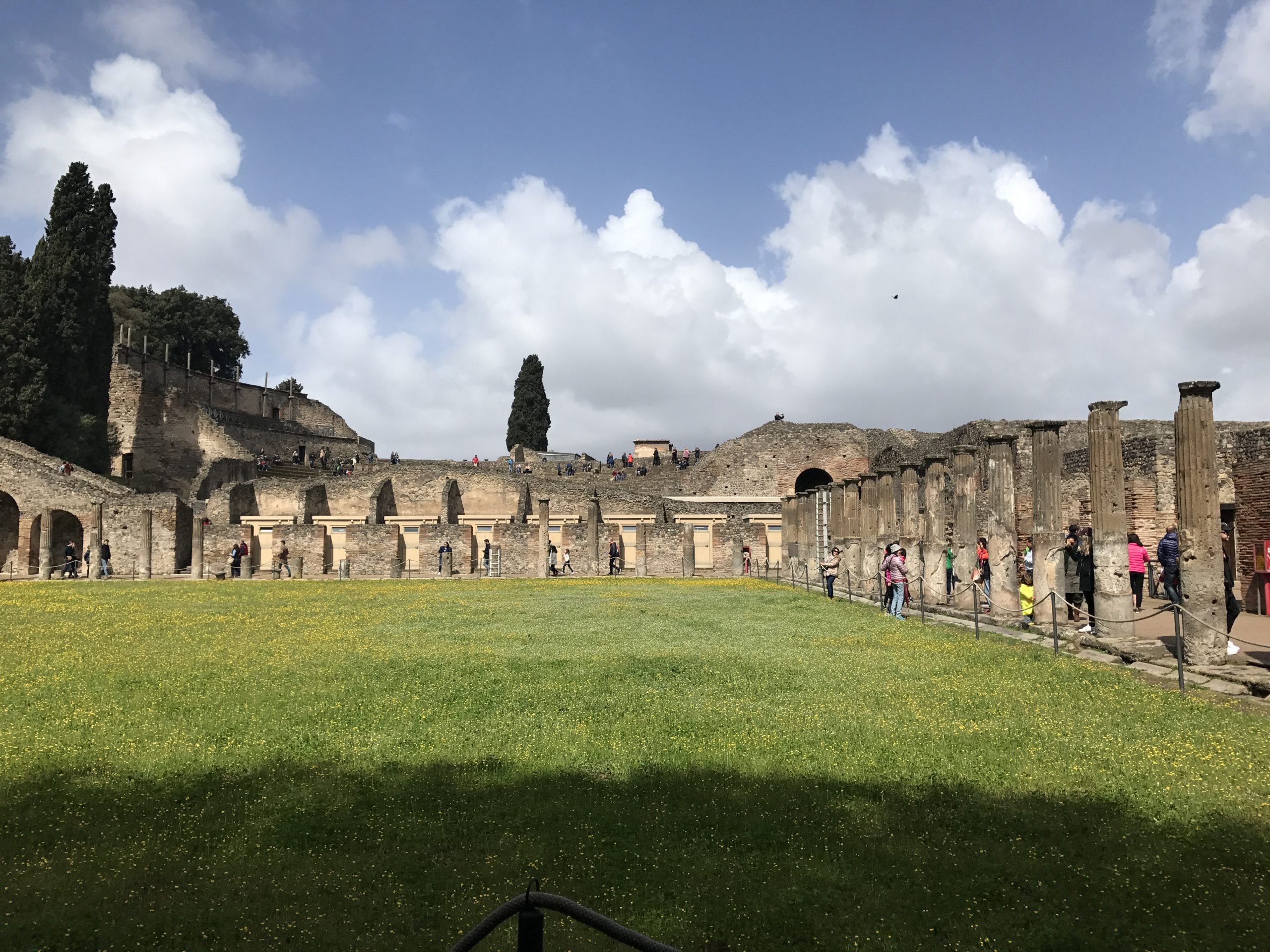
What Pompeii Actually Is — and Why It’s Worth Your Time
In 79 AD, Mount Vesuvius erupted with a force that buried the city of Pompeii under several meters of volcanic ash and pumice in less than 24 hours. Around 11,000 people lived there. Many escaped. Many didn’t.
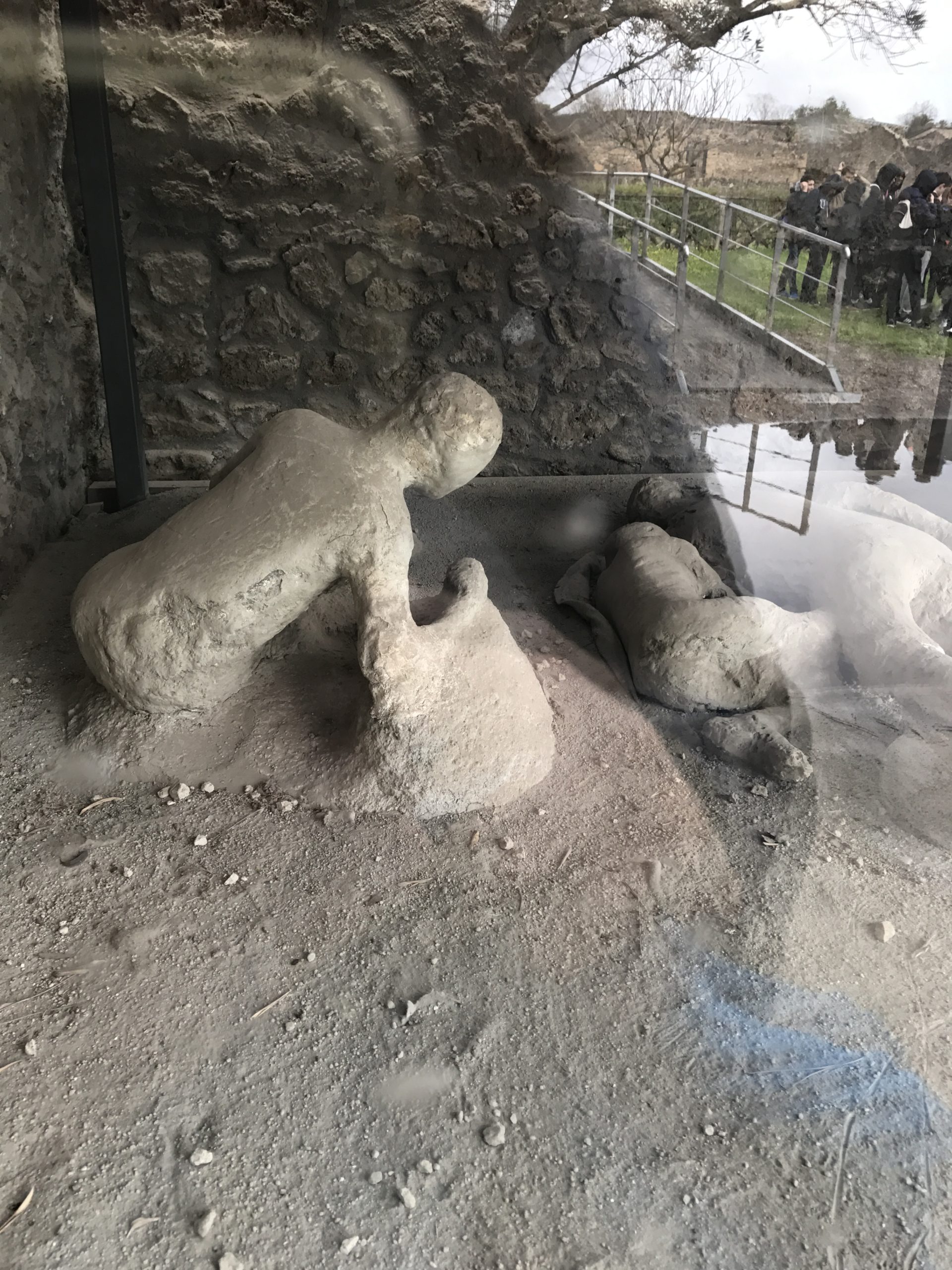
The ash did something extraordinary: it preserved the city almost perfectly. Not just the buildings — the frescoes, the food in the bakeries, the graffiti on the walls, the tools in the workshops, the garden furniture. And the people. The ash hardened around the bodies and left hollow cavities in the earth; 19th-century archaeologists had the idea to pour plaster into those cavities. The result is the plaster casts you’ll see in the museum rooms on site — people frozen in the exact position in which they died, 2,000 years ago. Some covering their faces. Some holding each other.
The site covers 66 hectares, of which about 45 are open to visitors. It’s not a ruin in the conventional sense — it’s a city. With streets, fountains, shops, temples, baths, an amphitheater, a brothel, private houses with intact mosaic floors, and gardens with original frescoes still on the walls. Walking through it doesn’t feel like visiting a museum. It feels like wandering through someone’s city that was interrupted mid-sentence.
How to Get to Pompeii from the Amalfi Coast
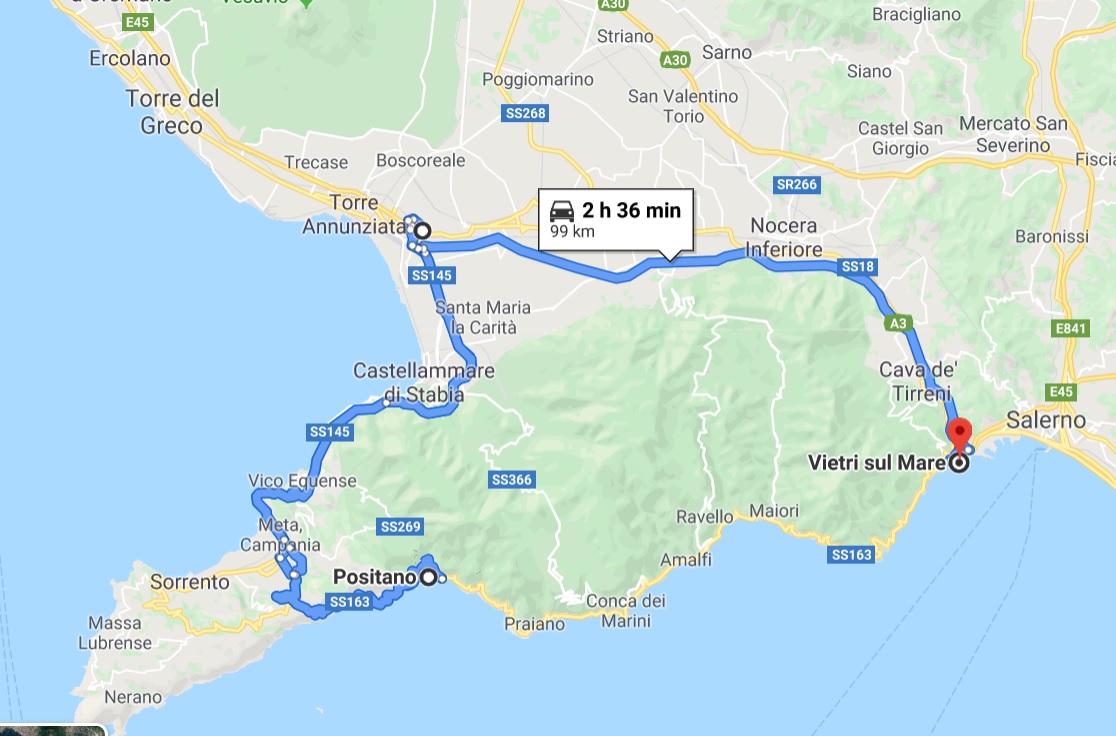
By car or motorcycle (what we usually do)
From Positano or Amalfi, the drive to Pompeii takes around 50–70 minutes depending on traffic. You head east along the SS163 to Vietri sul Mare, join the A3 motorway toward Naples, and exit at Pompeii. There’s paid parking just outside the main entrance at around €5–7 for a full day.
We’ve done this trip on the motorcycle many times — it’s a good combination because the SS163 along the coast is one of the most scenic roads in Italy, and Pompeii makes the perfect destination at the end of it. Leave early in the morning (by 8am if possible) to beat both the coastal traffic and the crowds at the site.
By train from Sorrento (often the smartest option)
The Circumvesuviana train runs from Sorrento to the “Pompei Scavi – Villa dei Misteri” station, which deposits you literally at the main entrance. The journey takes about 30 minutes and costs around €3.20. Trains run frequently throughout the day. If you’re based on the western part of the coast (Positano, Praiano), taking a ferry or bus to Sorrento and then the train to Pompeii is often faster and far less stressful than driving.
From Salerno or the eastern coast
From Salerno, Pompeii is about 30–35 minutes by car or a bus connection. If you’re based in Maiori, Minori, Cetara or Vietri, this is the closest major archaeological site on the coast — an easy half-day trip even without a full day to spare.
🚌 Want to go without the hassle of driving? Several operators run full-day tours from the Amalfi Coast to Pompeii, including transport and a guided visit.
👉 Browse Pompeii tours and transfers on GetYourGuide
Tickets — Book in Advance, No Exceptions
This is the most important practical advice we can give: do not show up at the gate without a ticket. Pompeii has a daily limit of 20,000 visitors and during peak season (April–October) the morning slots sell out days or weeks ahead. The queue at the ticket office in summer can be one to two hours. That’s two hours standing in the sun before you’ve even started.
Buy tickets online at the official site (pompeiisites.org) or through GetYourGuide. Tickets are timed and nominative — you need to enter your name exactly as it appears on your ID, and you may be asked to show ID at the gate.
Tickets & Hours — 2026
Adult: ~€18–20 (check current price at pompeiisites.org)
EU citizens 18–25: Reduced rate · Under 18: Free
Free entry: First Sunday of each month (Oct–Mar) — book online anyway, still requires timed entry
Apr–Oct: Open 9:00–19:00, last entry 17:30
Nov–Mar: Open 9:00–17:00, last entry 15:30
Closed: December 25 and January 1
Prices and hours subject to change — always verify at pompeiisites.org before visiting
Pompeii Express vs Pompeii Plus: The standard ticket (Pompeii Express) covers the main archaeological park and is what most visitors need. Pompeii Plus adds access to the suburban villas — including the Villa of the Mysteries — and connects them via free shuttle. If you have a full day, Pompeii Plus is worth it for the Villa of the Mysteries alone (more on that below).
🎟️ Book skip-the-line entry + optional guided tour
👉 See Pompeii tickets and tours on GetYourGuide
What to See — The Things That Actually Matter
The site is enormous. Without a plan, you’ll spend four hours walking and still feel like you missed everything. These are the things we make sure to see every time.
The Forum
The Forum was the civic heart of Pompeii — politics, religion, commerce, and public life all happened here. The scale is the first shock: this was a serious city, not a village. The columns of the Basilica (the ancient courthouse), the Temple of Jupiter with Vesuvius framed perfectly in the background, the municipal buildings around the square — it gives you the best single overview of what Pompeii was.
Start here. The Forum is near Porta Marina, the main entrance, so you’ll pass through it naturally. Spend time at the Temple of Jupiter and look at Vesuvius behind it — the same view the Pompeians had every day, never knowing what it was building up to.
The Streets Themselves
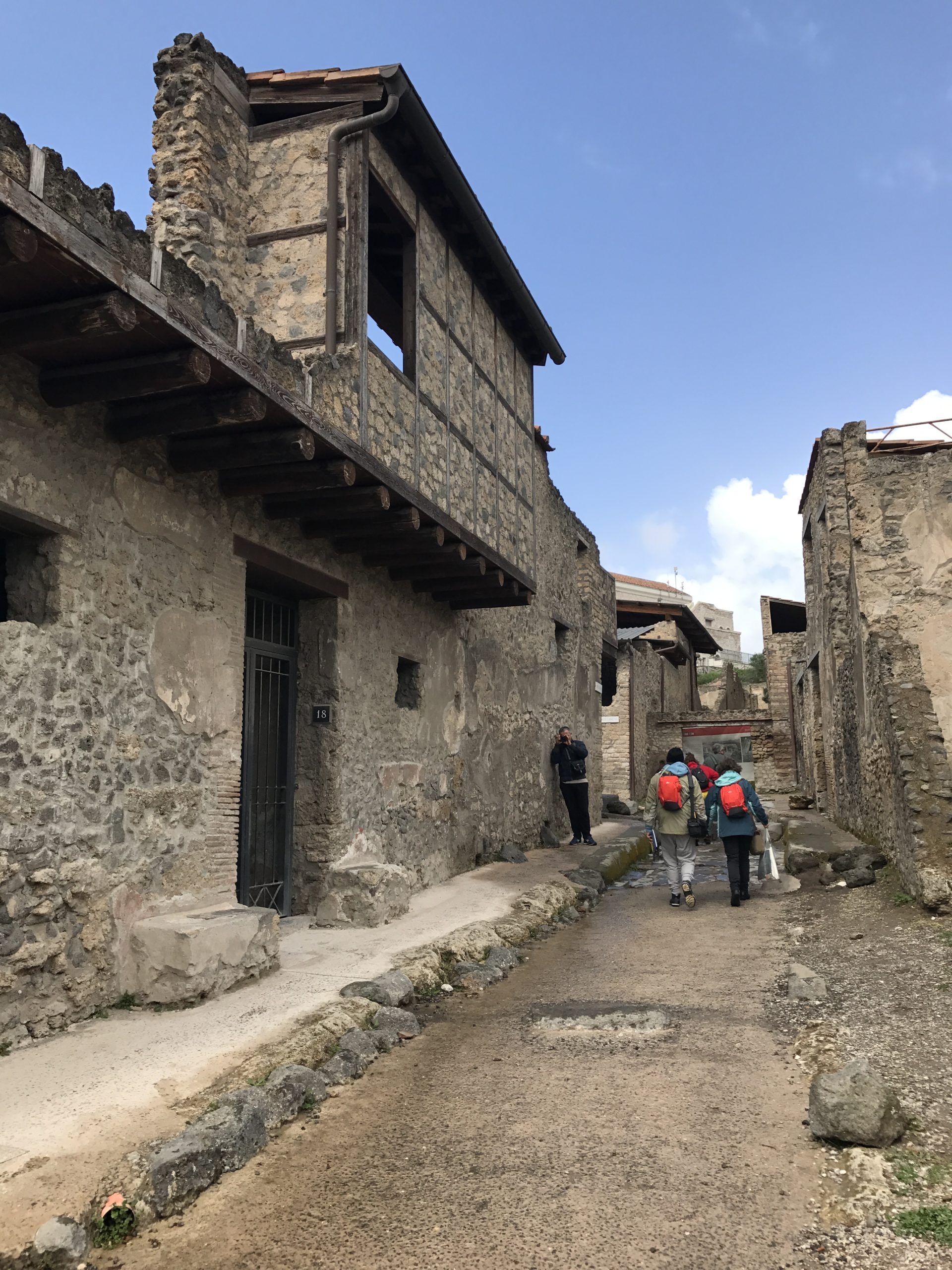
The streets of Pompeii are one of the most quietly extraordinary things about the site. They’re paved with the original stones, with deep ruts worn by cart wheels over hundreds of years. The large raised stepping stones let pedestrians cross the street without walking through the drainage channels running along the sides. The same channels that Roman sanitation systems used 2,000 years ago.
Walking these streets — not in a museum, but on the actual street — is what makes Pompeii feel different from every other historical site. You’re not looking at it through glass. You’re walking on it.
Practical note: The uneven stones are harder on your feet than they look. Comfortable, supportive shoes are not optional. We’ve seen people try to visit in sandals or fashion sneakers and regret it within an hour. Bring shoes you’d wear for a long hike.
The Plaster Casts — Garden of the Fugitives
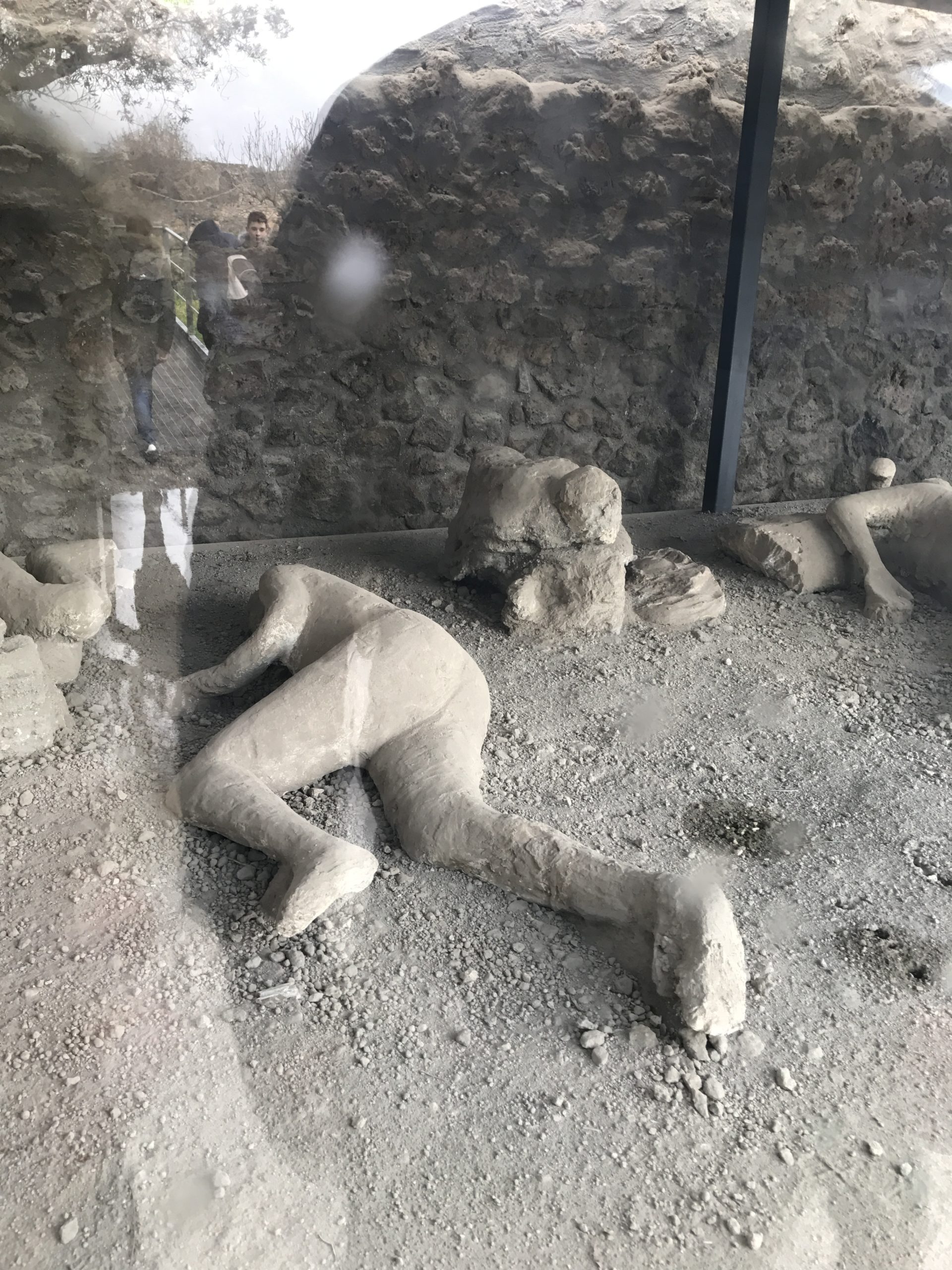
The most affecting thing in Pompeii. In the Garden of the Fugitives, a group of 13 plaster casts of victims — the largest such group in the park — are displayed where they were found. People who tried to flee. A woman curled on her side. A child. A man with his arm raised over his face.
The technique is simple: the bodies decomposed inside the hardened ash, leaving perfect hollow molds. 19th-century archaeologists filled the molds with plaster and revealed the forms of the people inside. The detail is extraordinary and disturbing in equal measure — you can see fabric, facial features, the exact position each person was in when the gases reached them.
Bring children, but prepare them beforehand. Our kids were moved and quiet in a way they rarely are anywhere. It made Pompeii real to them in a way no amount of explanation could.
The Stabian Baths
The oldest bath complex in Pompeii, dating to the 2nd century BC. Walking through it you understand immediately how sophisticated Roman daily life was — separate men’s and women’s sections, changing rooms, cold rooms, warm rooms, hot rooms, stucco decorations still intact on the ceilings. Public bathing was central to Roman social life; this wasn’t just hygiene, it was where business was conducted, gossip exchanged, friendships maintained. Still clearly legible 2,000 years later.
The House of the Vettii
One of the best-preserved private houses in Pompeii, belonging to two wealthy freed slaves who became successful merchants. The garden has been replanted with the original species found in the excavations, and several rooms have extraordinarily well-preserved frescoes — mythological scenes, portraits, trompe-l’oeil architectural details. It shows you what a wealthy Pompeian home actually looked like when it was lived in. Not ruined — furnished, decorated, inhabited.
The Lupanar (Brothel)
The best-preserved brothel in the Roman world, with 10 small rooms, stone beds, and — most famously — erotic frescoes above each door that archaeologists believe served as a menu of services, helping clients who didn’t speak Latin communicate with the workers. The graffiti carved into the walls are the most direct human voices in Pompeii: names, prices, ratings, complaints. One of the most visited rooms in the site; can be crowded.
The Villa of the Mysteries (Pompeii Plus ticket)
Just outside the main city walls, accessible by shuttle with the Pompeii Plus ticket, the Villa of the Mysteries contains the most extraordinary frescoes in Pompeii — and arguably the most remarkable surviving frescoes from the ancient world. The entire back room of the villa is covered in a continuous frieze depicting a Dionysiac initiation ritual, with figures that look almost photographically real after 2,000 years. The colors are still vivid. The expressions on the faces are readable. It’s genuinely one of the great things you can see in Italy, and most visitors who take the basic ticket miss it entirely.
If you have a full day, get the Pompeii Plus ticket. If you only have half a day, the main site is enough. But if this is your only visit to Pompeii, consider it seriously.
With a Guide or Without?
This is one of the clearest cases in Italy where a guide makes a significant difference. Pompeii is enormous, largely unsignposted, and difficult to contextualize without background. The difference between walking through a ruin and understanding what you’re looking at — the political systems, the social hierarchies, the religious practices, the trade connections — is entirely a guide question.
We’ve done it both ways. The guided version is better. A good archaeologist-guide will take you directly to the best-preserved rooms (many not on any map), explain the frescoes in context, show you the graffiti that most visitors walk past, and route you efficiently through the 45 accessible hectares in 2–3 hours. Without a guide, plan 4+ hours and accept that you’ll miss things.
🏛️ Book a guided tour of Pompeii — small-group tours with archaeologist guides, skip-the-line entry included, departing from the Amalfi Coast, Naples, and Sorrento.
👉 See all Pompeii guided tours on GetYourGuide
In the Rain — Yes, It’s Worth It
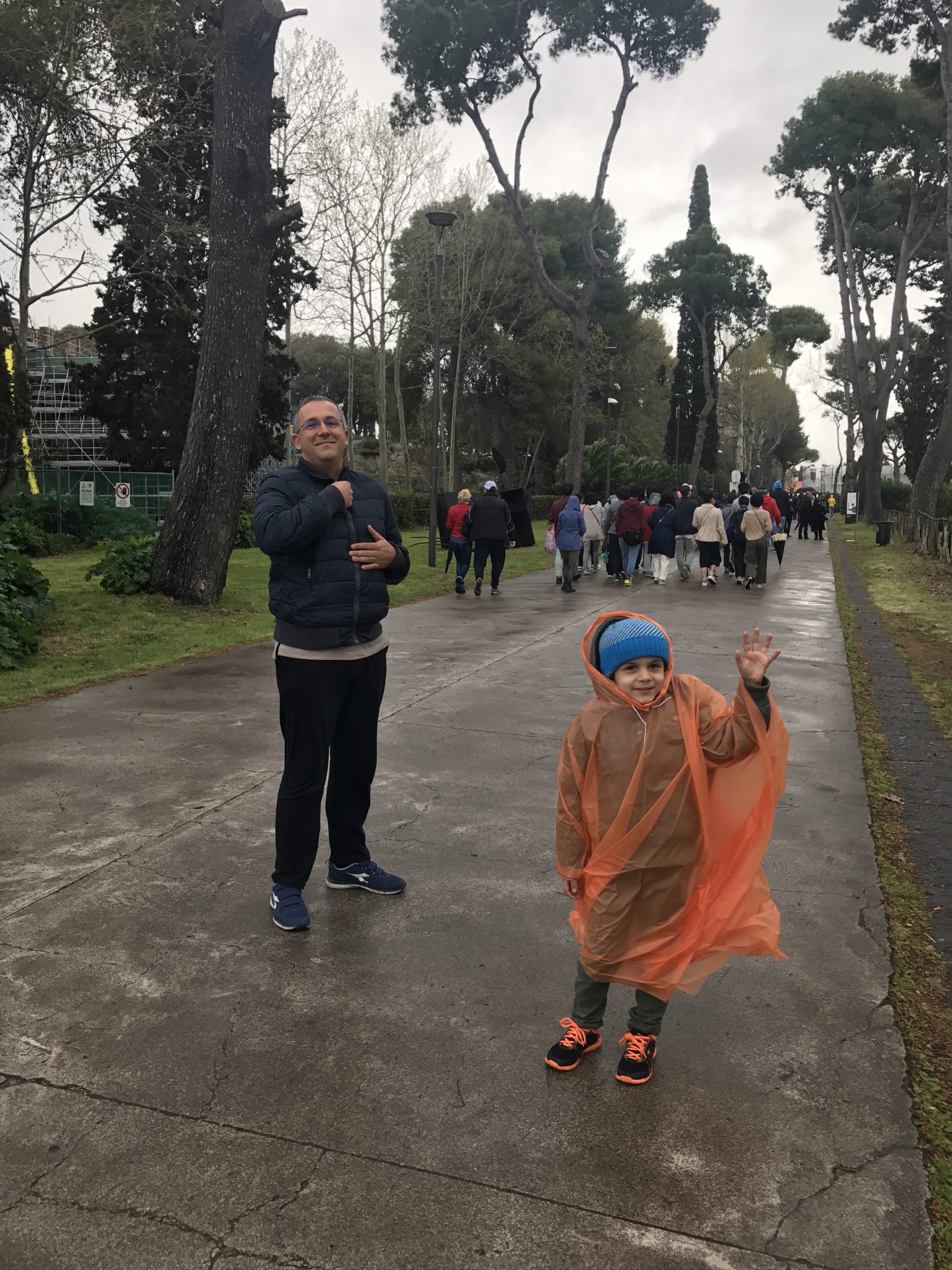
We visited Pompeii once in November, in the rain. It was one of the better visits. The crowds were almost nonexistent. The temperature was cool rather than brutal. The wet stones turned a darker color that made the site feel even more ancient. The sounds were muffled. You could stand in the Forum completely alone.
If the weather is bad on the day you planned to visit Pompeii, go anyway. Bring a waterproof jacket. The main structures have covered areas and porticoes. The frescoes in the houses are protected. The experience in rain is genuinely different from the summer crowd experience, and in our opinion often better.
Practical Tips — What We’ve Learned Visiting Multiple Times
Go early. The site opens at 9am. Arriving at 9am means an hour of relative quiet before the tour buses from Naples and the cruise ships start arriving around 10:30–11am. The Forum and the most popular houses feel completely different before the crowds. This is especially important in summer.
Bring water. The site has water fountains (look for the green taps, same system as in the towns of the Amalfi Coast). In summer, shade is limited and the heat between the stone walls and paving can be intense. A hat and sunscreen are not optional.
Wear shoes you can actually walk in. The original Roman stones are uneven, sometimes slippery, and hard on feet. Anyone who arrives in thin-soled shoes or fashion sandals will be uncomfortable within 30 minutes. This applies especially with children.
Bags larger than 30×30×15cm are not allowed inside. Free cloakroom at the entrance. Leave the large backpack there.
The free Sunday trap. The first Sunday of each month is free entry, which sounds great until you realize that the entire region knows this and the site is more crowded than any other day. If you can choose your dates, avoid free Sundays in the shoulder season.
Plan your route before entering. The official Pompeii app has a map and suggested routes. Alternatively, the entrance gives out a free paper map. Look at it before you go in and identify the three or four things you most want to see — the Villa of the Mysteries, the Garden of the Fugitives, the House of the Vettii, the Stabian Baths — and plan a route that covers them without excessive backtracking. The site is large enough that aimless wandering can leave you tired before you’ve seen the best parts.
Combine with Herculaneum if you have two days. Herculaneum (about 20 minutes from Pompeii by Circumvesuviana train) is smaller, less crowded, and in some ways even better preserved than Pompeii — the wooden furniture, the food, the organic materials survived in ways they didn’t in Pompeii. A combo ticket covers both. If you have one full day, Pompeii. If you have two, do both.
How Long Do You Need?
A minimum of 3–4 hours covers the highlights: Forum, some of the main houses, the Stabian Baths, the Garden of the Fugitives. You’ll feel like you’ve seen Pompeii.
A full day (5–7 hours) lets you go slowly, sit down, eat lunch at the site cafeteria, and see the Villa of the Mysteries with the Pompeii Plus ticket. You’ll feel like you understand Pompeii.
With children, build in rest time. The site has no playgrounds and limited shade, but kids generally find Pompeii genuinely fascinating — the plaster casts especially. Our children have been consistently more engaged here than in most conventional museums.
Where to Stay Near Pompeii
Most visitors to Pompeii do it as a day trip from the Amalfi Coast, Sorrento, or Naples. There’s no particular reason to stay overnight in Pompeii town itself unless you’re doing a multi-day archaeological itinerary that also includes Herculaneum and Vesuvius.
If you want to be as close as possible to the site for an early-morning entry:
- Grand Hotel Royal, Pompeii — closest to the main entrance, solid 4-star option
- Hotel del Sole, Pompeii — reliable mid-range choice near the archaeological park
- Hotel Ristorante Vittoria, Pompeii — family-run, good restaurant on site
- Hotel Palma, Pompeii — budget-friendly, walkable to the site
🏨 Or browse all accommodation near Pompeii:
👉 See all hotels near Pompeii on Booking.com
We’ve visited Pompeii multiple times — alone as a couple, and with our children. It’s one of the places that earns its reputation. All photos on this page are our own. Questions about visiting? Leave a comment below.