

Quick answer: Ravello sits 365 meters above the sea, has no beach, and contains two of the most beautiful gardens in Italy. You can do it as a day trip from Amalfi in 4–5 hours, but staying overnight — after the day-trippers leave and the town goes quiet — is a completely different experience. One we’ve had many times, and always recommend.
We first went to Ravello on a whim, driving up from Amalfi on a motorcycle because the road looked interesting on the map. We’ve been going back every year since — sometimes just for a long lunch and a walk, sometimes to stay two nights. The town does something to you. It’s the altitude, the silence, the gardens, the way the light falls on the coast below. Gore Vidal lived here for decades and called the view from Villa Cimbrone the most beautiful in the world. We’re not sure we disagree.
This is what we actually know about Ravello — after 15 years of visits, in every season, with a couple and later with two kids.
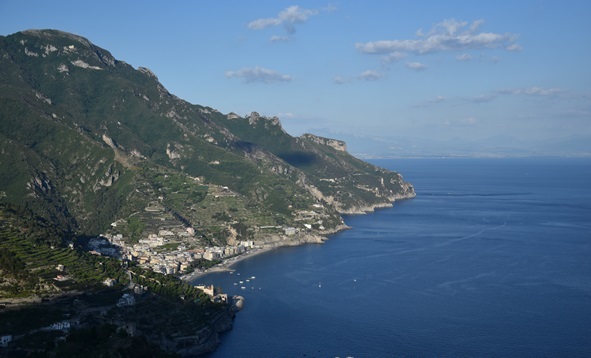
Why Ravello Is Unlike Any Other Town on the Coast
Every other major town on the Amalfi Coast — Positano, Amalfi, Cetara, Maiori — sits at sea level. Ravello doesn’t. It was founded in the 5th century, most likely as a refuge for wealthy Amalfi families who wanted safety and distance from the political turmoil below. They built their villas high on the mountain, and that altitude became Ravello’s defining quality.
The result: no beach, no harbor, no ferry connections. But also no cruise ship crowds pouring off the dock at 10am, no bumper-to-bumper traffic on narrow port streets, no noise except the church bells and, in summer, the sound of classical music drifting from Villa Rufolo at dusk. Ravello is what the rest of the Amalfi Coast used to feel like before the world discovered it.
It’s also genuinely cooler in summer — three to four degrees less than the coastal towns — which sounds minor until you’ve spent an August afternoon in Positano wondering if you’ll survive. On a warm July evening in Ravello, with a glass of local wine on a terrace looking out over the coast, it feels like a different planet.
The Main Reason Most People Come: The Villas
1. Villa Rufolo — start here
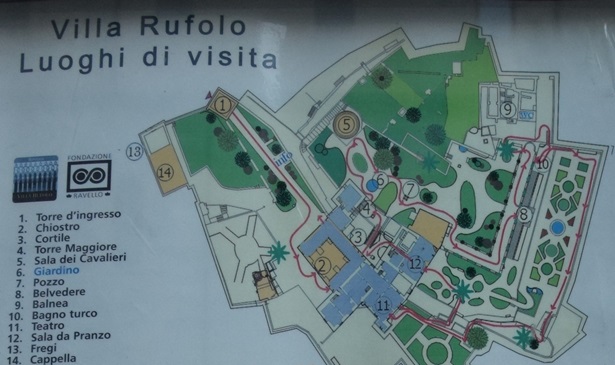
Villa Rufolo is the first thing you encounter when you walk into the main square. The entrance is right on Piazza Duomo, which means you can stumble into it without planning — and many people do. Built in the 13th century by the Rufolo family, one of the most powerful merchant dynasties of the Amalfi Republic, the villa hosted royalty, fell into ruin, was bought by a Scottish botanist in the 1850s, and then made history in 1880 when Richard Wagner visited and declared he had found Klingsor’s garden — the inspiration for the second act of Parsifal. That’s not a minor claim.
What you see today: a Moorish tower, a beautiful Arab-Norman cloister, terraced gardens bursting with color from spring through autumn, and two suspended terraces with panoramic views of the entire Amalfi Coast and the Gulf of Salerno. On a clear day you can see all the way to Salerno. On a summer evening, when the Ravello Festival stages concerts on the terrace with the sea as backdrop, it’s one of the most extraordinary settings for music anywhere in the world.
Our tip: Go at opening time (9am). The garden terraces are almost empty for the first hour and the light is beautiful. By 11am, group tours arrive and it becomes much more crowded. The view of the iconic umbrella pine rising above the twin domes of the Annunziata church — the most photographed image in Ravello — is best in the morning.
Villa Rufolo — Admission & Hours
Adults: €8 · Ages 5–12 and over 65: €5 · Under 5: free
Open daily 9:00–21:00 (last entry 20:30) in summer · Tower-museum: 11:00–16:00
Hours vary in winter — check villarufolo.it before visiting
2. Villa Cimbrone — the Terrace of Infinity
A 10-minute walk from the main square along a narrow lane lined with lemon groves and old stone walls brings you to Villa Cimbrone — and to the most famous view on the Amalfi Coast.
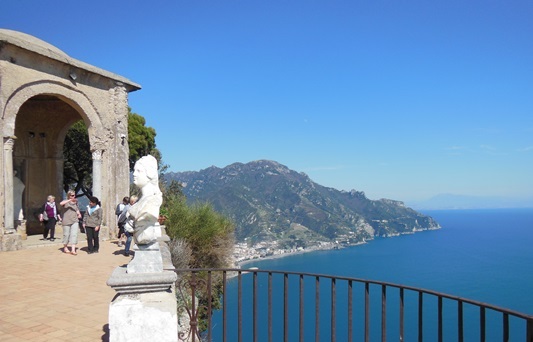
The Terrace of Infinity (*Terrazza dell’Infinito*) is a long balustrade of white marble busts looking out over the sea from a sheer cliff edge. The horizon stretches from Cape Palinuro in the east to the islands of Li Galli in the west. There’s no railing between you and the drop — just the marble ledge, the stone busts, and the sea 350 meters below. The first time you step out onto it, you stop walking. Every single time.
We’ve been here in May with flowers blooming everywhere, in October with the coast below turning gold, and once in a light rain when the mist over the sea made it look like a Japanese ink painting. The gardens around the terrace — paths through hydrangeas and wisteria, hidden pavilions, ancient statues, a small temple of Ceres — are large enough to wander for an hour and still find new corners.
Villa Cimbrone is now a 5-star hotel, but the gardens are open to the public.
Villa Cimbrone Gardens — Admission & Hours
Adults: €10 · 10-minute walk from Piazza Duomo
Open daily 9:00 to sunset, year-round
Go at opening time for the best light and fewest people
Do both or just one? If you only have a few hours, Villa Cimbrone for the Terrace of Infinity. If you have a full day, do both — they offer genuinely different experiences. Villa Rufolo is more structured, more cultural, more connected to the Festival. Villa Cimbrone is wilder, more romantic, more about the feeling of standing at the edge of the world.
The Cathedral (Duomo di Ravello) — Free and Almost Always Empty
Built between 1086 and 1087, the Cathedral of Ravello sits right on Piazza Duomo and is one of the most beautiful small churches on the Amalfi Coast. Most visitors walk straight past it to get to Villa Rufolo. This is a mistake.
The bronze doors, cast in Constantinople in 1179 by Barisano da Trani, are extraordinary — 54 panels depicting religious scenes with a precision that makes you stop and look twice. Inside: a 12th-century marble pulpit with mosaics of Jonah and the Whale (technically two whales, one for the swallowing and one for the spitting out), columns sitting on carved marble lions, medieval frescoes, and the Chapel of San Pantaleone — where, according to local tradition, the saint’s blood liquefies every year on July 27th. The museum in the cathedral complex holds sculptures, mosaics, and medieval artifacts.
It’s free. It’s quiet. There’s almost never a queue. In 15 years of visits, we’ve never waited more than a minute to walk in.
The Other Churches — For People Who Dig Deeper
Ravello has several small churches scattered through its narrow lanes, most of them free and almost always empty. If you have time and inclination, these are worth finding:
San Giovanni del Toro — Built in the 11th century by the noble families of Ravello, it has a pulpit decorated with Persian majolica from the 13th century and frescoes in the apse. The building has been closed for restoration in recent years; check locally if it’s open.
Santa Maria a Gradillo — One of the oldest churches in Ravello, once used as a meeting place for the town’s parliament. Simple, small, and genuinely atmospheric.
Chiesa dell’Annunziata — The twin-domed church visible from Villa Rufolo’s terraces, about 100 steps downhill. The view of this church from above, framed by an umbrella pine, is one of the most photographed images in Ravello. Worth descending for, especially with a camera.
San Francesco — A 13th-century Franciscan church on the road to Villa Cimbrone, with an adjoining cloister that’s usually open and quiet. We always stop here on the walk to Villa Cimbrone. Easy to miss, worth lingering.
The Ravello Festival — Worth Planning Around
The Ravello Festival has been running since 1953, and it’s become one of the most prestigious classical music events in Italy. Each summer from late June through September, concerts are staged in Villa Rufolo’s gardens on a terrace cantilevered over the coast, with the sea visible in the background and the last light of the day playing on the Amalfi Coast below.
We’ve been twice — once to a Wagner program (fitting, given Wagner’s connection to the villa) and once to a chamber music evening. The setting makes everything more powerful. Even music you might find unremarkable in a concert hall becomes something else entirely when you’re 365 meters above the sea with the stars coming out.
Practical notes: The most popular concerts — especially Wagner — sell out weeks in advance. Book online at ravellofestival.com before you travel if your visit falls in summer. Tickets range from around €20 for general admission to €60+ for premium seating. Dress code is smart-casual; no beachwear.
🎵 Browse tours and experiences in Ravello — guided walks through the villas, cooking classes, Amalfi Coast day trips, and transfers.
👉 See all Ravello tours on GetYourGuide
The Hike Down to Amalfi — One of the Best Walks on the Coast
One of the things we most recommend in Ravello — and one of the things most visitors skip — is walking down to Amalfi or Atrani instead of taking the bus back. The path begins behind Villa Rufolo and descends roughly 1,500 steps through terraced lemon groves, small hamlets, and old mule tracks. It takes 1.5–2 hours and is downhill almost the entire way.
You pass through Torello (a hamlet with extraordinary views, almost no tourists, and a few cats), then through olive terraces and small gardens to Atrani on the coast. From Atrani it’s a five-minute walk to Amalfi.
We’ve done this walk in the morning (best light), in the afternoon (golden hour on the lemon groves), and once in the rain (surprisingly atmospheric — the stone steps become slippery, so slow down). The only requirement: proper walking shoes. The path is uneven stone and wet conditions make it genuinely treacherous in sandals.
An alternative to the full walk: go as far as the hamlet of Torello (about 45 minutes) for the views, then turn back up. Challenging enough to feel earned, short enough to do before lunch.
What to Eat in Ravello
Ravello has fewer restaurants than Positano or Amalfi, and most are oriented toward tourists willing to pay for the views. The honest approach: one meal somewhere with a panoramic terrace (worth it once), and at least one meal in a local trattoria where the view is zero but the food is real.
Rossellinis at Palazzo Avino is the headline option — Michelin-starred, extraordinary views, extraordinary prices. For a special occasion, genuinely excellent. We’ve been once as a couple. The lemon risotto was one of the better dishes we’ve eaten anywhere on the coast.
Cumpa’ Cosimo on Via Roma is the local institution — family-run, no-frills, packed with actual Ravello residents, and serving the kind of pasta and grilled meat that reminds you Italian cuisine was never about restaurants with views. Portions are huge. Book ahead in summer.
The aperitivo at Villa Rufolo terrace — available to non-ticket holders in the evening — is one of the best value experiences in Ravello. A glass of local white wine with the coast below you at sunset costs around €8–10. This is the right way to end a day here.
What to eat: scialatielli (the local pasta), any fresh fish, the lemon-based desserts (*delizia al limone*), and local wine from Tramonti — one of the most underrated growing areas in southern Italy.
Where to Stay in Ravello
We covered this in detail in our dedicated hotel guide, but the quick version: Ravello has fewer hotels than Positano or Amalfi, they fill up fast in summer (especially during the Festival), and the best ones are genuinely special. The town is pedestrian-only in the center, so you’ll park outside and walk in — confirm this with your hotel before you arrive.
One thing that tripped us up once: some properties in Ravello involve a serious uphill walk from the road. Not a problem when you arrive fresh, very much a problem at 11pm after dinner with luggage. Ask how far the property is from the main parking area and from Piazza Duomo before you book.
🏨 Looking for a hotel in Ravello? We have a full guide with honest picks by budget — from the Belmond Caruso to reliable mid-range options and the best budget guesthouses.
👉 Read our Ravello hotel guide ·
Browse all hotels on Booking.com
Getting to Ravello
By bus from Amalfi (easiest)
The SITA bus from Amalfi to Ravello runs regularly throughout the day and costs around €1.50 each way. The journey takes 20–30 minutes up a series of switchbacks through the Valle del Dragone. Buses leave from the main SITA stop in Amalfi; check the current timetable at the bus stop or the SITA website. This is what we use when we visit without the motorcycle.
By car or motorcycle
The road from Amalfi up to Ravello is spectacular — narrow, winding, lined with lemon trees, with glimpses of the coast below at every turn. We’ve driven it dozens of times on two wheels and it never gets old. In a car, it’s narrower than you’d expect, with passing places in some sections. In summer, a traffic light system controls the alternating flow at the narrowest point.
Parking in Ravello: there’s a paid parking lot at the entrance to town. Expect to pay around €3–5 per hour. Do not try to drive into the pedestrian center — you can’t, and the fine if you manage it isn’t worth it. Park, walk in, the center is small enough to cover entirely on foot.
By motorcycle specifically: the road up to Ravello is one of the better motorcycle routes on the coast, but the parking area is shared with cars and tends to fill up in summer. Get there before 10am if you’re going in July or August.
By taxi
Available from Amalfi, typically around €30–40 for the one-way trip. Worth it if you have luggage, if you’re visiting at night for a Festival concert, or if the bus schedule doesn’t suit. Ask your hotel to call one — taxi drivers in the area know the road better than anyone.
There is no ferry to Ravello
Ravello has no port and no sea access. All connections are by road. If you’re basing yourself in a coastal town and want to visit Ravello, the bus from Amalfi is always the right answer.
A Practical Day in Ravello
This is the day we’d do if we had one full day and wanted to cover everything without feeling rushed:
9:00am — Arrive at Villa Cimbrone right at opening. The gardens are empty, the light is right, the Terrace of Infinity has nobody on it. Spend 90 minutes here. This is the priority.
11:00am — Walk back to Piazza Duomo via Via San Francesco (stop at the cloister). Look into the Cathedral — five minutes, free, one of the better things in Ravello.
11:30am — Villa Rufolo opens properly and is busy but manageable. The terraces and the Moorish cloister. Allow an hour.
1:00pm — Lunch in Piazza Duomo or on Via Roma. If it’s a weekday, try to get a table at Cumpa’ Cosimo.
3:00pm — Walk down toward Atrani or Torello (the hike we mentioned above). Or just wander the lanes — Ravello rewards aimless walking more than most towns its size.
6:00pm — Aperitivo on the Villa Rufolo terrace. This is non-negotiable. The coast in the golden light with a glass of local wine is the single best free-ish experience in Ravello.
If staying overnight: Dinner at 8pm (book ahead), then the town after 9pm when it’s completely quiet and genuinely magical. Morning in Ravello before the day-trippers arrive is worth setting an early alarm for.
Ravello With Kids — What to Know
We’ve taken our kids to Ravello multiple times, first when they were quite young. A few things that made it work:
The town is compact and mostly flat once you’re on the main plateau — very different from the relentless stairs of Positano. A small child who can walk independently can handle most of Ravello without being carried. Villa Cimbrone has enough garden space to keep kids interested (the statues, the paths, the occasional cat). The Paper Museum in Amalfi makes a good complement to Ravello for a full day — Ravello in the morning, Amalfi in the afternoon.
One honest note: the Ravello Festival concerts run late (typically 8–9pm) and are not ideal for small children. The villas and the town itself are the family-friendly part.
We visit Ravello every year, usually at least twice — once in spring when the gardens are in full bloom, and once in early autumn when the crowds thin and the light turns gold. All photos on this site are ours. If you have specific questions about the town, leave a comment below.